
The title of John Proctor is the Villain is immediately grating. Of course Proctor, from Arthur Miller’s The Crucible, is awful; he seduces a teenager and then casts her out as a “whore”; he’s a bad husband, a bad master, a fairly average citizen of Salem. But he admits his sins and dies! What more do you want?
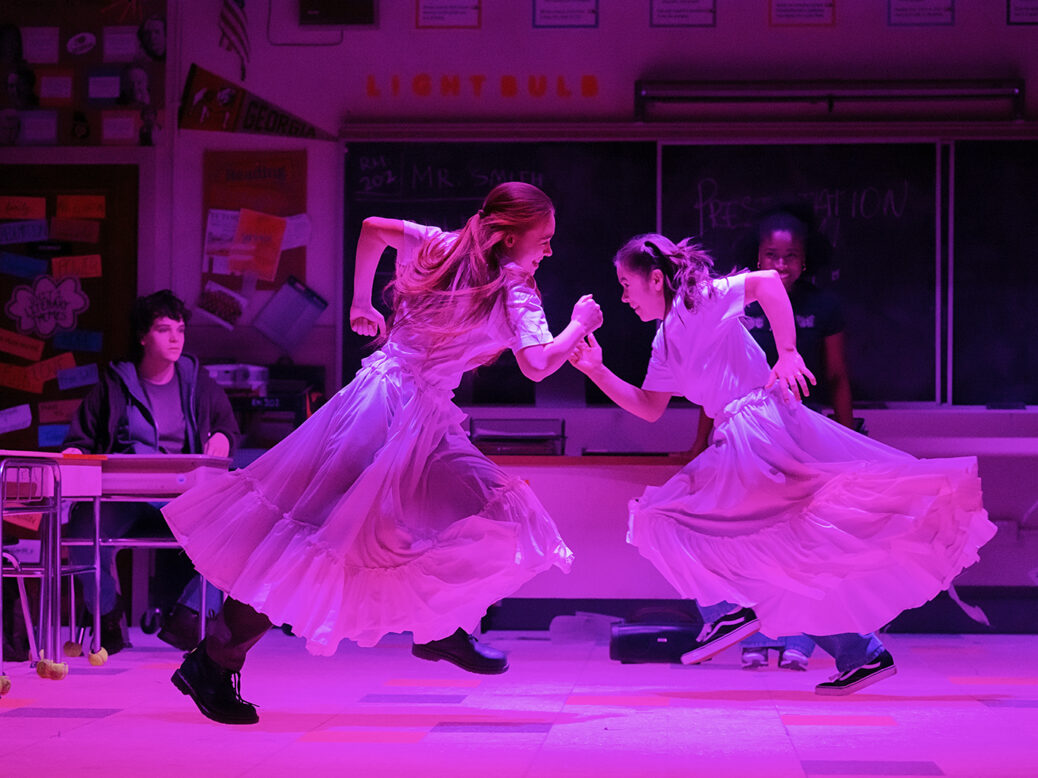
Kimberly Belflower’s play puts Proctor, Salem and 1690s, 1950s and 2010s misogyny under the microscope. John Proctor Is the Villain was a hit when it first appeared on Broadway last year, directed by Danya Taymor and starring Stranger Things’ Sadie Sink. Now Taymor, with much of the same creative team, has brought the show to London’s Royal Court theatre. Despite the title and the simplicity of its argument, the play is thrilling to watch.
We are in an English classroom in a rural “one-stoplight” town in Georgia. The play is set in 2018, a period piece from the first Trump era, post-MeToo, pre the abolishment of Roe vs Wade. The set, designed by AMP featuring Theresa L Williams, is a meticulously dated classroom, covered in motivational posters and church leaflets. The girls talk about Taylor Swift and Glee and BuzzFeed. All their jeans are high-waisted.
The students are reading The Crucible with their cool, feminist teacher, Mr Smith, (a charismatic Dónal Finn), who sings Lorde in the classroom and tells them how much he loves Joan Didion. Mr Smith sometimes clashes with Miss Gallagher, a sweet woman played by Molly McFadden – Kerry Katona’s daughter! – but together they help the girls launch a feminist society. One girl, Shelby (Sadie Soverall), the “town slut”, has been absent from school for six months and no one knows why – especially not her former best friend, Raelynn.

The cast is mostly excellent – Holly Howden Gilchrist is funny as the nerdy Beth; Miya James’s portrayal of Raelynn’s insecurities is astonishingly good. Only Soverall’s performance feels occasionally forced.
Shelby comes back and spins everything into chaos. It is revealed that one student’s father is an abuser; a male student is sexually aggressive.
The girls start to question Miller’s text. Shelby thinks Abigail, traditionally the villain, was “awesome” and John Proctor’s insistence on clearing his name was mere vanity. (Never mind that Abigail wanted a lot of women dead, never mind that the witch trials would never stop if everyone kept lying. These are pointless quibbles.)
One by one, man after man falls down. Meanwhile, the women remain pretty saintly. Nell, a new student from Atlanta, complains about people saying she’s “too much”. “What they really mean”, she says, “is just, Nell’s a girl”. Tired lines like this might have worked better on an American audience. My toes curled at Shelby’s declaration, “I contain frickin multitudes”.
All nuance is lost in the final beats of the play, set to Lorde’s “Green Light”. But it still leaves you invigorated. You want to cackle and dance and cry with these witches. Who cares if the men hang?
[Further reading: Lily Allen’s revenge tour]
Content from our partners



Related



Join the debate
Subscribe here to comment